Saturday, February 22, 2020

Conti GP5000 TL - R&R

I ran over a cluster of goat-heads when rolling away from a pedestrian stop-light button and picked up 3 goat-heads. I coasted to a stop while leaning the bike so the side they punctured wouldn't contact the road. 2:3 came out without penetrating the tire, but the 3rd one went in oriented across the tread and made a small puncture. The tire would still hold air for 40-50 miles, but I'd lose about 5psi, and it continued to seep sealant, so I decided to try Stan's Race Sealant on the recommendation of a friend, and see if that would seal the leak.

I'm not a fan of just adding more and more sealant in the hopes it will eventually drown the leak, so I removed the tire and set about cleaning it. I discovered that public car washes that use pressure washers do a great job getting tire sealant out. You get a completely clean and toothy tire ready for more sealant. If you can't get it to seal under pristine conditions, you're never going to get it to seal in the wild, so this is the best way to seal a slow leak.

What was left in my tire was a clear, somewhat sticky, gelatinous liquid that keep leaking out of the small puncture, but it contained no sealing beads/bits, so it was incapable of sealing the leak. This creates a dilemma because the sealing bits that plug the hole are all stuck to the tire, but to add more sealant you need to release all the pressure, and when you do this with the Conti 5000 TL it lets go of the bead, so you have old sealant stuck in the bead, and all over the inside of the tire, and you have to reseat the bead. That tire is never going to seal up well. The old sealant creates all kinds of gaps along the bead. The only solution is to thoroughly clean the tire, wheel, valve and re-tape the rim. That Conti's TL always lets go of the bead is a design problem.

Unfortunately, this time the tire came out with a lot of damage to the bead, inner casing, and sidewall, in spite of not washing the sidewall per-sec, only the inner & outer bead. Last time, at a public car wash, no damage at all. Hummm.


I should have done this before, but after letting the tire dry in the sun and inspecting it, I Googled to find how much pressure public high-pressure car washes actually use. It looks like 1,200 to 1,500 except for trucks, which can get to 2,200psi. The washer I used was borrowed from a generous friend and is rated 1,800psi, which, combined with a very narrow nozzle turned out to be too much in this case. I think if I had used the 45 degree nozzle, instead of the 25 degree, I would have ended up with a very clean but undamaged tire.

RX the 40 degree, not the 25 degree nozzle

Pressure washing is BY FAR the best way to remove old sealant, but do it right away before it has a chance to dry on the tire, and maybe even soak overnight in detergent soap. At any rate, I decided to take this opportunity to revisit my RX for installing the GP5000 TL tires, as this one was a new, but an older production 25mm tire and was crazy hard to get on. It took every trick in my book to get it on, but it did go on without damage, and no bead seating or leakage problems. Either Conti has some serious QA problems, or they have changed their spec, and loosened the bead somewhat. As the last two I've put on - one a 25mm, and one a 28mm - have both gone on easily, I'm guessing they changed their spec.

The tire held 90psi from an initial 110 psi after 20 hrs. I assume that was mostly from the tape seating into the spoke holes, the tire expanding somewhat overnight, and a small amount of normal leakage through porous rubber and around the bead and stem.

If you're here burning daylight trying to get out the door for a ride, I'll cut to the chase. Here's were I ended up getting this incredibly tight & difficult tire mounted. Njoy!

Zip-ties are like another set of hands +1


KoolStop tire jack played no role in finally getting the tire on

Obviously a LOT of prying was done to get the tire bead up & over the rim's edge. PBS tire plastics are great because they have a groove that engages the tire's bead so you can push the bead up towards the rim's edge a bit before starting to pry. I tried using the KoolStop tire jack, but though it took yet another bite out of my rim's decals, I was unable to get the bead over the edge of the rim using it. The ZipTies on the other hand were priceless. They absolutely work, every time, all day long. I cut the ties loose from L2R from the valve and the tire settled into the center cavity like magic.

As per my prior post on mounting this tire, mounting the 1st bead starts at the valve, but the 2nd starts across from the valve, keeping both beads pushed down as deeply into the rim's center cavity as possible as you go, finishing up at the valve where the beads are forced outward around the valve's base. Sans the valve area, both beads were hard against the center cavity at all times. This was one tight tire! The Zip-ties keep the tire from crawling down the rim away from you all the time. A really great discovery!


Tire Cleaning Procedure:

I guess I should say right here that pressure washers and rims should never meet. You don't want to get water inside the rim, remove the LocTite on spoke heads, or get water under the airtight rim tape. You also don't want to risk damaging the bearings by blowing water and grit past the seals on the hub's bearings.

So what to use? Alcohol, a tire plastic, a stiff cloth and some elbow grease.


Valve Cleaning Procedure:

Always clean the valve thoroughly before installing it again. This includes the inside of the valve body, the rubber seal, and the tapered seal that is pressed against the rim-tape. My SO bought a set of stainless steel straws (a little hard on the teeth IMHO) at BigLots and they came with a cleaning brush, but I see Amazon sells these brushes stand-alone.
 

Used valve body. What a tiny passage!

I prefer to clean the seals with my finger tips. For the black one pictured above, use the stippled nut that holds the valve closed to turn the stalk counter-clockwise (the "Open" direction) while holding the seal between your index finger and thumb, (or whatever method you prefer) and just rub the sealant off as gently as possible. Those are some very delicate seals, so tread lightly.

New valve. White Teflon & black rubber seals showing


Given that all the air or CO2 you'll ever put in your tires has to go through this very small passage, it should be obvious how important it is to keep both this and the stem clean. It's also the reason I had to use all High-Flow connections and couplers on my 120psi air-compressor system to insure a quick bead-seat, which it does without fail.

SS drinking straw cleaning brush


White plastic bead on tip is go/no-go sizing device


Damaged Goods:

Though I'm pretty sure this tire could be mounted and it would hold air, it has a lot of damage, especially to the bead area. The threads showing through almost everywhere on the sidewalls are disturbing, as are the strings/chords/fibers showing through on the inside of the casing. There's also quite a bit of rubber missing from the ribbed area that runs from the center to the bead on the inside of the tire casing.

Those ribs are probably one reason this tire has such low rolling resistance, and give the tire such good sidewall strength even when going flat. By contrast, the inside of Schwalbe's tire looked like a golf ball, with thousands of tiny dimples.

I'm sure some of the damage you see here was done by the pressure washer, but given that Conti's TLs always let go of the bead, there's no option of injecting more sealant without having to re-seat the bead on top of old sealant, or remove the tire and clean everything thoroughly and then reinstall the tire - which I still think is the best option. 

Lots of bead damage


Sidewall and bead both pretty chewed up


Extensive damage to the bead area

This looks like puncture damage

Cracked rubber and loose threads

This could be damage, but the hole looks too clean

Note the casing ribs

Why are these casing threads exposed?

Not the bead surface that engages the rim, but still...

Sidewall chords showing around the entire tire

Note tread-wear dimples


I think you can see why I chose not to remount this tire. I am keeping it as a spare, but you can see, it is far from being used up based on the tread-wear dimples. My only consolation is that this tire did yeoman's work for almost a year and performed brilliantly.

I still think the Conti5kTL is the best thing going, but I would like to see some guidance from Conti about cleaning, mounting and caring for their TL tire, and hopefully, find a way to get the bead to hang on at zero pressure. To that end, I hope someone from Conti reads this report and the company responds in a helpful way. I'm a huge fan of the tire, but groping around for solutions to problems is getting tedious.

Cheers!

PS:
Thirty mile ride today and happy to report the new tires roll better, soak up bumps better, and do a better job of killing road-buzz. As much as I like the wear dimples, I'm going to set my own minimums for these tires based on visual inspection and road feel. I have no doubt a 25mm on my back wheel would wear out long before these became issues, but not on the front wheel. Very happy with my decision to replace the tire. Already ordered another 25mm as a spare. The old tire is getting tossed.

Also should report, it may be the Stan's Race Sealant, but the tire lost ZERO psi over the last 48hrs. That's a first for ANY tire for me.

Wednesday, February 5, 2020

Indian Summer

The weather was really nice here last week, in the 60s and even low 70s (down here in the valley anyway) so I sucked it up and put in some ride time, logging over 120 miles in a week, not my best week by far, but my best week since moving down to SoCal in 2015, so a lot of time looking at this view.

Apple Valley Airport. A favorite hydration stop

I was stopped for a short break, against a sun-drenched wall out of the cool breeze when this guy happened by on a trike. I saw him 6-7 blocks away, and was surprised at how visible he was, both front & back. Love the little bits of serendipity when out riding. We waved and shouted a greeting and he was gone.


 My, how time flies! I can't believe I've been here (almost) 5 yrs already! Apple Valley, Victorville & even Hesperia have come a long way in making this area more cyclist-friendly. The big, signature piece in that was putting in 3 nice river-front segments called the Mojave River Walk (there is a 4th in North Victorville, but it isn't connected) They've also put in a short segment of bike trail up to the VVC campus, but it's pretty steep.

Victorville has also installed small repair stations (they were badly vandalized in Sacramento, so watching this with interest here) and near VVC, a small park & picnic ground with drinking fountains - two of them. This one right along the river walk Surprising how often this critical piece of infrastructure is overlooked, especially here in the high DESERT, so check this fountain out!

Elkay drinking fountain with bottle-filler

I've never seen a bottle-filler in a drinking fountain, and am glad it's in full sun, which is what sterilizes ALL public drinking fountains, because the nozzle is shaded by the top of the fountain, but the bottle medallion is reflective, and the water was clean, city water. There's also a doggie fountain about 6" off the ground, which we also appreciate. It's hot and dry here, so simply taking a drink is not enough to keep you hydrated, you need to carry water on you, so this makes perfect sense. Sacramento, are you listening?

The newest of the 3 segments of the Mojave River Walk skirts the Mojave River Narrows, where the Mojave meanders through a low, flat swampy area and comes up through springs to make nice, little lakes like this one. 

Mojave Narrows Park

I've also been working on my nutrition a bit, and am happy to report that the Elderberry gummies are as effective an anti-oxidant and anti-inflammatory as the USDA claimed they were (they stopped publishing anti-oxidant values because it was abused for commercial purposes, but I have a screen print of the table somewhere). Much more effective than ibuprofen, heart-friendly, gut friendly and a big boost to your immune system.


My bike is creaking again. It's the headset. The crown race I'm pretty sure. I bought a new one, but haven't installed it yet. I think the Cane Creek 110, guaranteed for 110 yrs, is defective in that the crown race isn't rigid enough, but I will need to inspect it carefully when I tear it down. The blue paint is worn off on 1 side for about 60 degrees around. I assume that is the side facing the down-tube, but I won't be sure until I get it apart.

Very cold last night, down to 17 degrees here in the valley, and only in the 40s today, with 70s the next 3 days, so debating staying home and fixing the creak.

I haven't ordered it, but I'm going to add another IRBM mirror to the right handlebar end. Too many times I'm at an intersection unclipped and can't see behind me, which is bad now that there's a lot of construction going on and cars are having to squeeze by. Tic, toc.

Ciao!

Tuesday, January 21, 2020

Cycling Hand Signals +1

I was watching a documentary on auto-pilots (there's no such thing BTW, despite Elon Musk insisting the misnomer is no more egregious for cars than planes) and when interviewed about "rouge drivers" the software designers complained that they don't play by the rules of negotiating on the road. "Negotiate" is EXACTLY the right word, as cyclists have to negotiate with motorists all the time to stay safe. In fact, whenever a motorist/s starts looking perplexed, START DIRECTING TRAFFIC!!!

We're all familiar with cycling turn signals, stick your left or right arm out to indicate a turn in that direction, because unlike motorists, both arms can be seen. There's also the raised arm for stopping, but I've never used it and you shouldn't either.

The Big Three

Keep your hands on your brakes where they belong when stopping. I crashed and fractured my pelvis going 12 mph because the sand at the intersection was like grease and I had my right hand off the brake blocks to signal a turn. Yeah, I wish I could do that one over. To hell with signalling, maintain control of your bike at all times. This is EXACTLY the advice my flight instructor gave me years ago as a student pilot (yes, I've had my ticket for 35 yrs). This is NOT to say you shouldn't signal. It is a reminder that signalling, and everything else too for that matter, is secondary to controlling your bike.

With the above for context, I'm introducing a new hand-signal. It's simple & straight-forward - a signal for going straight-forward. No, really. Here's the silly simple +1

Slash the air forward from your elbow, motioning your forearm from your shoulder to the straight-forward position. Pretend you're slashing a ribbon at the end  of a race. 
Repeat the motion 2-3 times.

This is so helpful I'm amazed I have never heard of it or seen it in print. Here's why...

  1.  It tells a motorist directly across from you, going straight, that they can proceed immediately.
  2. It tells a motorist directly across from you, wanting to turn R, that you aren't turning L, so they can proceed immediately.  
  3. It tells a motorist directly across from you, wanting to turn L, they have to wait for you to clear the intersection. For cyclists, this is the most common source of collisions with motorists.
  4. It tells motorists on your L that you aren't turning R, so they have to wait, because you won't be in the bike lane on the other side of the intersection from them, you'll be right in front of them for a few seconds.
  5. At a 4-Way Stop, it tells everyone you intend to roll straight through the intersection, clearing it ASAP, so if they hold on 5-7 seconds you'll be out of their way. Direct traffic as required, slow & be generous, but take charge!
  6. It tells motorists you aren't lazy or inept, that you aren't just neglecting to signal, but are going straight through the intersection, not turning either L or R.

Try it. I think you'll agree, it has an amazing effect on your interaction with motorists. 


Thursday, December 19, 2019

Italian Road Bike Mirror


Between clueless installation instructions, and inept fan videos, I'm surprised this company is still in business. The reason it IS in business, is it's a really GREAT product. Somehow, road vibration is just GONE!

The 4 fingers go UNDER your bar tape

Sometimes something is so improbable you know you must be missing something or it'd be long gone. In this case, the size of the mirror seems ludicrous, but this is one of those VERY rare items that's the result of endless trial & error refinements, and it shows immediately when you start to actually use it. If not for the Conti GP5kTLs, this would easily be my Product of the Year Pick.

Like most right-handed riders, when I stop I only unclip my left foot, leaning the bike slightly against my left thigh. Every bar-end mirror I've ever ridden before gets knocked out of alignment when doing this, but not the IRBM. Don't get mirrors with ball-joints. They're never in alignment, and tightening down the ball joint just leads to failure. It's an idea that seems like a good one, but ends up being as welcome as a stone in your shoe.

After breaking 3 of the Hafney handlebar end mirrors (constantly getting bumped, and readjusted for aerobars) I was fed up enough to look at mirrors again. This in spite of having an eyeglass mirror that I used for a few rides, and AGAIN, rejecting it. 

For me eyeglass mirrors require too much time to get into position to see something somewhere behind me. They also cause a lot of neck strain, as holding your head in THAT position can be painful as the miles wear on.  I also don't like getting an eye-full of my Hi-Viz shoulder and adding a blind-spot. Bottom line, by the time you've gotten a good look at what's behind you, you've ridden far enough to get in trouble.

That's dangerous, but it does bring up an important point. There's more to mirrors than size, in particular, the following are the most important features of a bike mirror...
  1. Clarity, which is really two things, the quality of the mirror's optics, and
  2. Vibration-free operation
  3. Time to acquire a useful sight pic
  4. Bump resistance - maintaining its adjustment ride after ride
  5. Riding position tolerance (like riding in aerobars and it still works!)  
  6. Durability (essential on event rides in strange areas)

Those were the biggies, but there are some other considerations too...

  1. Aerodynamics
  2. Ease of mounting
  3. Price

The clarity, according to the mfg's statement, is due to a "front-silvered (also known as a “first-surface" mirror.) The glass has a vacuum deposited hard aluminum coating on the front, it is not “silvered” on the back like a common mirror. This front-silvering eliminates ghost images which are seen in common rear surface silvered mirrors. A front-silvered mirror displays the most accurate reflected image." It's really remarkably brilliant and clear.

I wish I knew how this mirror manages to be so vibration-free. It's just amazing, and incredibly valuable. It also makes getting a good sight-pic much, much faster. Getting a sight-pic is the time it takes to see what you want to see. The Hafney were very fast, but then you couldn't see anything clearly. The eyeglass mirror is the slowest. The IRBM is very close to the Hafney, but you CAN see what you're looking at, not some perpetual blur of something.

I've known about this mirror for over a year  now, but passed on it because, come'on, it's tiny, and you can't even adjust it (not quite true, btw). It was the repeated urging of a friend that finally forced my hand. Mounting this mirror was my biggest turn-off. WTF?  A mirror you can't adjust? (but also can't knock out of adjustment!)


Mounting the Mirror:


1st, the included instructions are idiotic, and an insult to my intelligence, as they show how to mount the mirror with handlebar tape taped from the center of the bars down to the ends. Stupid! NOBODY wraps tape that way. You wrap from the bar-ends to the center, AND, that's actually very helpful as it turns out. Before I forget, when ordering new bar tape, which you'll need, buy an extra set so you get 3 tries to get the mirror taped before you run out.

You're going to need some trial & error to get the mirror mounted correctly - mostly in the up-down direction. So, to do that, as the tape goes OVER the mirror's "fingers", you need to strip the tape off the end of a bar. Guess what, when you pull the plug out of the end the tape doesn't unfurl like toilet paper in a hurricane, it CAN'T. To remove it you have to tear it off one wrap at a time. Do that until 4-5" of bar-end are exposed and leave the rest of the tape alone!

Put a rounded bar-end cap on the bar. No, NOW, before you forget and have to start all over from scratch! You don't want the sharp end of the bar gouging the back of the mirror mount (as per included instructions) Without any bar tape to push against, you're going to need to tape it in place with electrical tape. A 6" piece folded over the plug leaves plenty of stick for the bar. The more rounded the plug's shape, the easier it is to get the correct adjustment. Something domed, plain and unadorned is perfect. Nothing to dig into the back of the mirror.

Domed & unadorned, too flat, adorned. #1 for the Win!

I'm assuming your bars are just how you want them, so this procedure is NOT going to rely on you moving your bars. Put the 4 fingers over the bar, wrap your hand around the bar end, and pull on the fingers until the mirror is looking directly behind you with the horizon going right through the middle of the mirror.  A long hallway where you can mount the bike is very helpful. Now wrap some tape (Cinelli's finishing tape is perfect for this - easy to R&R) around the fingers to tack it in place. Wrap as much or as little tape on top of that as you like - enough so you can go for a test ride. I had to pull my fingers a LOT to get the sight-pic I wanted, but the IRBM easily pivoted over the domed bar-end cap and held nicely when taped.

Remember how I said you CAN adjust this mirror just a bit? By twisting the mirror you can move the sight-pic inboard or outboard, and that's very helpful. It won't stay there forever, but it will for a few minutes. This works better if you don't wrap electrical tape all the way to the bar ends (you're going to wrap everything with bar tape eventually anyway, so completely unnecessary). Just tack it well enough it will survive replacing bar tape in the future. That's enough. 

Go for a ride! Take some mental notes. Tweak for perfection riding on the hoods. Twist on the mirror, tug, pull, spindle, mutilate like it's your Birthday!

If you used the finishing tape that comes with bar tape (which I NEVER use as intended, preferring electrical tape) it's easy to make adjustments as you ride, stop, ride, stop, rinse & repeat. Got it where you want it? GREAT! Whip that 3M tape out of your jersey and wrap the ends of the fingers until they are in full contact with the bar, but leave the last 3/4" to 1" at the end of the bar loose to facilitate twisting for sight-pic. 

Once you're home again, remove all the old bar tape and retape your bars. Start by cutting a long, shallow taper about 3" long from the center to the edge of the tape. You'll end up with a 3" long wedge of scrap. That tapered edge is the part you can't stick inside the bar where the plug normally seals it in place. 

Note end of wedged-shaped section at 2 O'Clock position

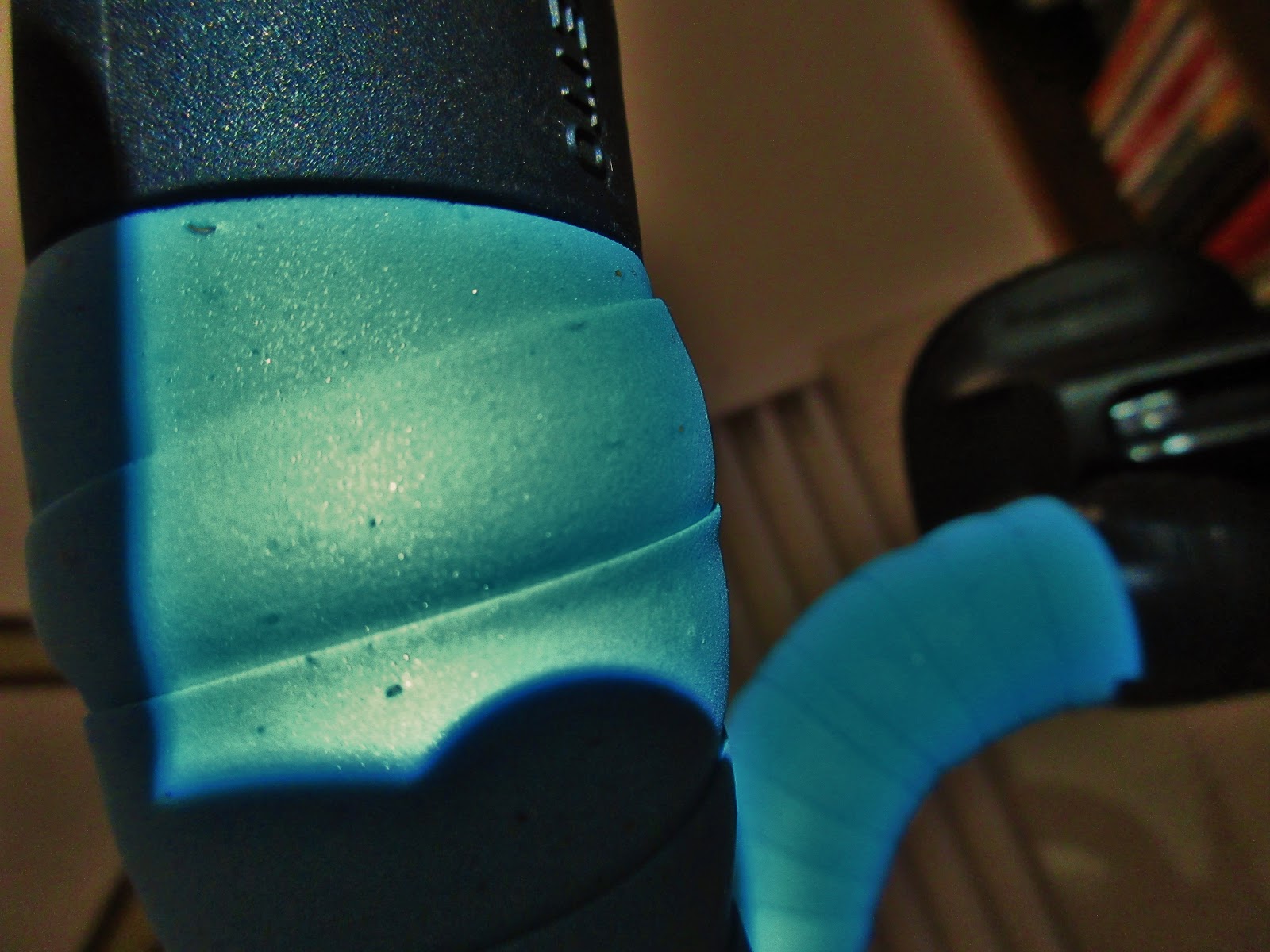
Place the tapered tape end to start at the 2 O-Clock position (looking forward from the back of the bike) with the flat, uncut edge against the base of the mirror. Hold it there while starting the tape by pulling it under the bar-end toward you until you've overlapped it with the next layer of tape when coming over the top, the tape edge held hard against the base of the mirror. 

Factory edge held flush against mirror base all the way around

You'll need a little bit of a loose wrap to spare tape usage all the way along, as the extra diameter will leave you short otherwise, but other than that, just wrap the bar like you always do, and finish it off with whatever finishing tape you like. MISSION ACCOMPLISHED. 

Another view from the bottom
Full-width of tape seen here, partially exposed,  9 O'Clock position

Zoom-out from 9 O'Clock position

The mirror can now be twisted clock-wise or counter-clockwise to move the sight-pic in or out, but otherwise it's rock solid. Absolutely bump-proof, and you get a fast sight-pic with no vibration whether on the hoods, tops or in aerobars. I'm afraid in the drops all I can see is my arm, but YMMV. (making the "OK" sign with your thumb and forefinger and twisting your arm outwards uncovers the mirror nicely though). 

The optical quality of this mirror is spectacular, enough so that it's worth cleaning the mirror before you start a ride. It's a small thing, but it helps. Use a cleaning cloth from an old pair of sunglasses. You don't want to scratch the reflective surface, which is on the face, not the back, of the mirror.

BTW, in spite of appearances, this mirror actually sticks out LESS than the Hafney mirrors with their ball & bracket system. It's also, OF COURSE, much more aerodynamic. I don't think this is going to create any Strava Heros, but every little bit helps. Look at the stuff Wahoo is doing with their GPS mount. 

Normally, in the US, the mirror goes on the left side, BUT, there are times when having one on the right side would be nice. For instance, if on a street where you have to move out of the bike lane, cross 2 lanes of traffic, and get into a L-Hand turn lane. You really can't see what's going on behind you as you move across those 2 lanes of traffic. I know it's a small thing, but it could save your life. 

I almost got run over coming upon a major intersection with no bike lane, 2 lanes going forward, and a dedicated L-Hand turn lane morphing out of nothing (no turn lane on the road anywhere else). There's also a shallow climb the last 300 yards or so before the intersection. It was near the end of the ride, I was tired, and the road had some gravel in it. When I took my hand off the bars to signal I started to wobble, so a very short and late hand-signal. A pickup decided at some point (too much vibration on the Hafney to see clearly) to pass me on the left. I took a good guess, straightened out my line, abandoned my turn, and he went all the way around me, crossing the center line, and then back into the lane I was still in ahead of me. 

If I had realized in the moment what an asshole thing he'd done I guess I'd have swore a blue streak at him, but as it was I was just happy that somehow, someway, everything had worked out sorta OK. The look on the faces of the other 20 or so drivers at the intersection was one of pure wonder and horror. It's like watching a train wreck - that somehow miraculously never happens. Long story short, a R-Side mirror would have allowed me to track the traffic behind me as I moved across 2 lanes into a dedicated L-Hand turn lane.

I have to say, I had no idea how many times I was checking my mirror until my Hafney mirror broke 10 miles from home. I'm guessing every 30-45 seconds. That's a BIG void when missing. Also, if you ride with a partner it's great to have mirrors AND headlights with Day-Flash mode. We both use CygoLite 1100 lumen lights, and you can see those in the IRBM for up to a mile. It keeps you from leaving your partner by the side of the road with a mechanical - or worse.