Showing posts with label Look Keo Carbon Blade Pedals. Show all posts

Tuesday, November 24, 2020

LOOK Carbon KEO Blade Grease Failure

About half-way home yesterday, on my 1st good ride since dental surgery (hammered the hell out of it!) I started to hear the birds chirping like it was a beautiful spring day, not a beautiful winter day. The "birds", I started to notice, stopped singing when I stopped pedaling - well at least when pedaling hard. I was hoping it was a dry chain, or even the bottom bracket, but after some 1-legged pedaling, pretty sure it was a dry pedal. 

I just checked my tracking info, and I got those the last week in October, so, gulp, that just flat out SUCKS! Here's the deal (channeling Joe Biden already), a lot of bike shops are struggling to stay open, so are selling anything and everything they can get their hands on. Shimano is back-ordered for months I'm told (somehow Competitive Cyclist was able to get me a replacement set of R-8000 shifters so I can fix the front, L-hand shifter. Giant Kudos there), and bike mfgs are complaining they could make more bikes if they could get components from mfgs. Post COVID, people have rediscovered the Great Outdoors, apparently all at once. Manage your gear accordingly.

BOTTOM LINE: Don't assume new purchases are new, were stored correctly (why run the AC when the physical store is closed?), handled correctly, or even assembled by the usual assembly fairies who may be sick with COVID. When you buy something that can be greased, grease it before installation. 

I'm hoping against hope that the spindle on the right pedal isn't ruined, or wasn't ruined by spalling of the needle bearing, I did use a very fine polish to polish the spindle, and it looks much better now, but I won't know for a few rides if I caught it in time.

Visine bottle repurposed with 0W20 Mobil-1
 First, remove the pedals like this. A great cheat is to remove the Right pedal first using a socket wrench with a ratchet, as it's threading is normal. When you're all finished with it put it back on & tighten it down per torque spec. The socket wrench's ratchet will now be set correctly to untighten the Left pedal. I bought a 3/8", 8mm allen tip as a 1/4" socket wrench is too small to untighten the spindles as they tighten themselves ever more as you ride. If you're dead certain you won't screw this up, I'd RX a 1/2" to 3/8th socket adapter so you can use a breaker-bar to break them loose. I'm not that certain.

 Right pedals loosen by turning counter-clockwise, left pedals loosen clockwise. 

Right pedals tighten by turning clockwise, left pedals tighten counter-clockwise.

Shimano marks their pedals with arrows, so use those as a guide if in doubt.

 A ~ 32" length of 2x4" lumber makes a great crank-arm crutch to keep the crank fully extended upright, which you can push down on without impaling your knuckles on the teeth of your chainring. Just flip the bike over and tuck the 2x4 under the flat side of the pedal, step on the horn of the seat, then wrench away!

I don't have the special 5-tooth tool to remove the lock-caps, but they came off with a rubber spacer (a piece of leather belt would probably work too) from an old tail-light and a shiny new Vice-Grip with a circular jaw pattern. I used Q-Tips to clean out the tiny bit of grease left inside. I then used Mobil-1 oil (from a repurposed Visine bottle) to clean out the needle bearing by flooding the inside of the pedal with oil & then turning the spindle with a small drill and 8mm allen wrench at ~ 300 rmps. 

Mother's Headlight Polish

 If you're going to polish the machined needle bearing interface on the spindle, do so before using the 0w20 oil and spinning the bearing with the drill, because if there's debris on it you might scratch the rollers of the needle bearing with a chewed up spindle cone. I used this Mother's headlight de-fogger which has an "ultra-fine abrasive" - probably hydrolyzed silica, AKA soggy sand, which is used in toothpaste, based on the color. Lapping compound at ~ 2,000 grit would be safer, if I had it on hand. A hard piece of denim or quality paper towel work well to hold the compound against the spindle with a hard hand pinch. More is less, so tread lightly, but get them nice and shiny without reshaping the spindle. 

Whatever you do, make DAMNED SURE there is no abrasive of any kind left on the spindle. I washed mine off with hot, soapy water, dried it with paper towel, and then immediately wiped it with oil.

Note rubber jaw-shield in ViceGrip

After cleaning the threads of the lock-cap and upper part of the inside pedal body with alcohol, as those threads need to be squeaky clean to allow the LockTite to bond during final assembly, I used FinishLine Teflon-fortified grease for the body and the main "permanently lubed" sealed bearing. After cleaning out the hollow at the end of the spindle with a Q-Tip, I packed it with grease too.

Using the Krytox syringe, I applied a zig-zag pattern of grease on the machined bit of the spindle that engages the needle bearing. As there's no way to reach the needle-bearing, I carefully reassembled the spindle and spun it with a drill to get some Krytox onto the surface of the needle-bearing itself. I repeatd this 3 times until I was sure I had a good Krytox coating on both the bearing and the spindle.

I then squeazed about a 1" length of lube into the pedal body. Not wanting to push the Krytox GPL 205 off the machined needle-bearing interface of the spindle when pressing it into place, I then repeatedly slammed the pedal body down onto a rag-covered bench to force the grease to the bottom of the pedal cavity. I had to repeat this process twice, adding grease again, to fully pack the pedal. 

Listen for a grease "crack" when doing a trial reassembly and tightening of the lock-cap. Excess grease will get pushed past the cassette bearing's seal in time, guaranteeing it gets relubed, even if it's supposed to be "lubed for life". The primary job of grease is to slowly bleed out the oil it holds. More grease, more oil, more bearing life. It will add 50gr to the weight of your bike. Do you care?

Once fully packed, turn the pedal with the drill and 8mm allen tip. You should see grease coming out of the pedal end of the sealed bearing interface. Wipe with a clean rag and repeat until the grease stops oozing out. You should then be ready to back the lock-cap off to expose the threads so you can apply LockTite. 

The seals on the lock-cap are very good, so if you cleaned them thoroughly with alcohol they should still be clean & dry. Apply 2 drops of BLUE Medium strength LockTite (I used Permatex. Same stuff AFAICT) covering 3-4 threads from the outside in. Hand tighten (the left side lock-cap is left-hand threaded - as is the spindle) as tight as you can and then use the 5-tooth special tool or soft-mouth pliers or Vice-Grip to tighten until snug. There's a thin rubber seal at the base of the threads the lock-cap is meant to engage AFAICT. The seal on mine was cracked & dried, but the Lock-Tite is both a thread-locker and a sealant, so don't sweat the O-ring seal quality.

Blue "LockTite", by whatever name, takes 24hrs to fully cure, so no pedaling until TOMORROW. 

Remember, the left pedal spindle is reverse threaded. Turn it clockwise to remove the pedal when facing the crank arm. The right side is normal, so turn it anti-clockwise to loosen it.

Have a Happy Thanksgiving! 


Excess Grease Oozing out of Bearing

PS: Did a hard climbing ride just now and happy to report the pedals are quiet. It will take a few more rides for the grease to get pressed out to an equilibrium quantity, but this is very encouraging. No indication the lock-caps are going to unscrew themselves, and no grease leakage on the left side spindle at all. 

PPS: I've put about 175 miles on these pedals in the last week and they are now glassy smooth, smoother than when I first took them out of the box and mounted them - by far. Weather has been 45-65F and there is still a small bit of grease coming out of the seal on the R pedal (packing the hollow of the spindle is probably responsible for this), which is just fine with me. It guarantees all the rust, debris and microscopic bits of spall, if there are any, are getting pushed out of the main bearing, and no water or dust is getting back in. 

Cheers!


Tuesday, November 17, 2020

Biking To-Do List: November 2020

First, yes, I still owe you all 2 posts on the theory and practice of half-step gearing, which is slow going at the moment, but I'm working on it. 

Second, I decided to repack an old set of Shimano Ultegra 6700 carbon pedals and was shocked to find there is no main bearing, and the "needle bearing" isn't a needle bearing at all, it's a home-brew dual ball bearing where the cups are ground into the ends of a ~ 12mm steel barrel, and those balls are teeny tiny, like something out of a Swiss watch. We're talking flat-sided toothpicks for handling all 36 of these 3/32 little devils. The PD-R8000 is made exactly the same way.


Third, I'm still trying to figure out a way to salvage my old bike's headset by using a thicker grease meant to resist being hammered out of the contact area (pound-out). Turns out there's a grease sold by AmsOil made specifically for this purpose used in heavy duty off-road earth-moving equipment - Synthetic Polymeric Off-Road Grease, NLGI #2

Think articulated joint in the center of a bucket loader rolling over rough ground with a bucket load of ore and a huge weight stack at the extreme other end of the machine. (these guys couldn't get laid in a mattress factory, but watch the video anyway) You'd want the thicker NLGI #2 grease for headsets retrofitted with sealed bearings with much smaller engagement areas than the original press-in ball bearing cups.

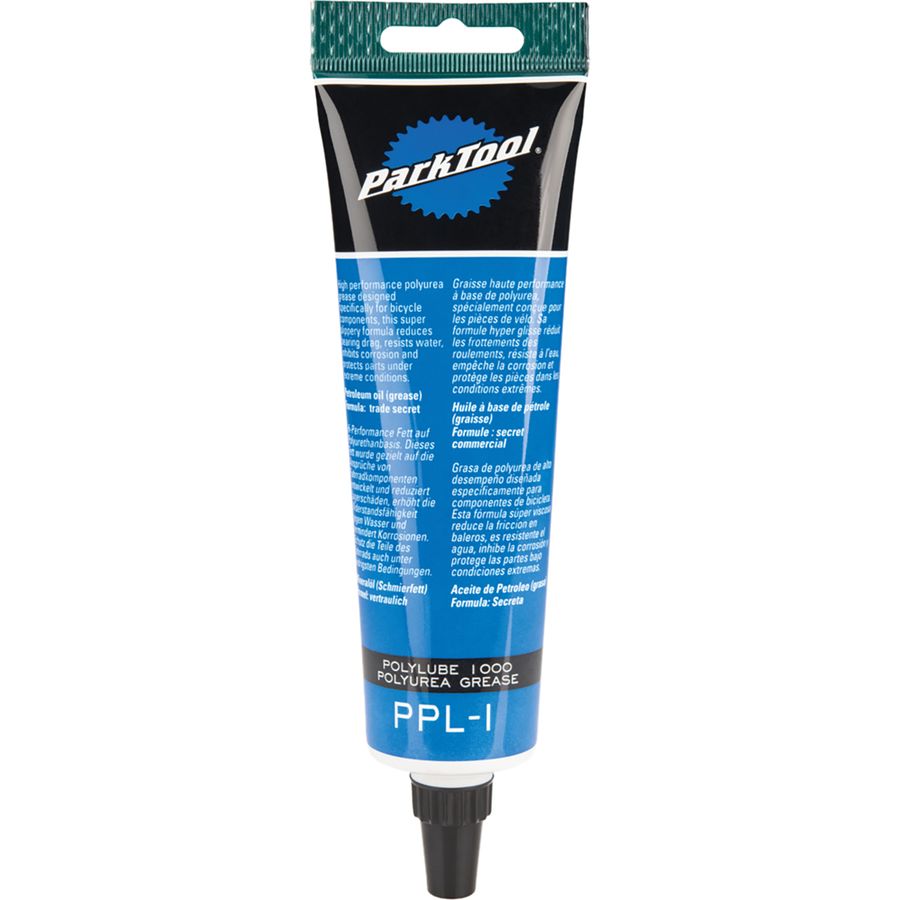
This, and repacking my Ultegra pedals led me to a lengthy investigation of grease, and especially, compatibility of greases with different bases (they're not), because I bought some of Park Tool's PPL-1 Polylube poly-urea grease, and I wanted to be sure it would play nice with other (primarily lithium-based) greases. Park Tool says it does. My research says NO. 

BTW, the base isn't the lubricating agent. The base is the stuff that gels and suspends an oil, and slowly weeps the oil onto a bearing over time, but it's NOT the primary lubricant (some additives like moly or graphite provide lubrication as well). That is to say, the base is what makes something a grease instead of an oil. There's a fairly wide window of bearing speeds and loads where grease works, and bicycle bearings are way, way inside that window. Easy-peasy. 

10% ball bearing failure @ 45,000hrs

By way of contrast, high speeds, high loads, and high heat make active lubrication under pressure with oil absolutely necessary for ICE engine main "bearings", which aren't bearings at all, but bushings with oil galleys cut into them, while hypoid gears' very high pressure loads in manual transmissions require very thick oil that can stand up to molecular shearing, but no active, pressurized lubrication system is needed there.

At any rate, I leaned a ton of interesting and important information about grease, when it's used, and how to select it. There's a really brilliant blog post in this if I'm up to the challenge. I do want to assure you all though that I'm very happy with all the RX-es I've made on this blog, and in particular, I still think for ball bearings running at the speeds (50-250 rpms) and pressure loads of bicycle hubs, BBs, headsets (my special need notwithstanding) and pedals, pure Teflon grease directly on the balls, cups & cones, and Teflon fortified grease to displace dust, water, etc in the rest of the grease cavity, makes the best possible lubrication. 

 If this changes I'll shout it from the rooftops, but I don't see that happening for decades. FinishLine makes both the pure Teflon grease and the Teflon fortified grease. I bought some Krytox GPL 205 10yrs ago and paid $65, but it's gotten cheaper. I still have about 1/4 left, so yes, I use it sparingly, but it will never leave you metal to metal and is chemically inert, so it won't react to metal, plastic, paint, etc. If you're riding disk brakes and the hub is soaking up a lot of heat, PTFE grease is about as good as it gets.

With COVID-19 running rampant everywhere again, as predicted, please do take care to stay safe at all times - 90% of the time will get you killed with this remorseless executioner.


Monday, October 5, 2020

Look Carbon Keo Blade Pedals - CrMo

THANKSGIVING UPDATE: I had to repack these brand new pedals 6 weeks after receiving them as they were squeaking badly. YMMV, but why take the chance? Get the special 5-tooth tool if you can find it, but repack these bearings before even mounting them. They come with almost NO grease, I assume to keep claimed weight to the bare minimum, but that's a very poor trade-off IMHO.


I bought a pair of new Look Keo Carbon Blade CrMo pedals, as my Shimano Ultegra were getting pretty ratty, and the Look are $50 cheaper these days. In fact, you can get the Ti Ceramic Look Keo Carbon Blade pedals online for less than the list price of the Shimano Ultegra carbon. SMH. Not this guy.  $135 from Colorado Cyclist with the FALL discount (out of stock now I see), no tax, no shipping charges. 

They mount the same, but are positioned much differently, so it took a bit to get them dialed in, and is still a work in progress in truth. You CANNOT unclip from the Look pedals by twisting your heel inwards, which is my habit with my L foot, the one I always disengage. That's been problematic, but hoping with time my muscle memory will adjust. 

UPDATE: You CAN disengage by twisting your heel inward, but it takes ~ 3X the force. Weird, as the mech looks symmetrical. 

After the cleats wore into the pedals a bit, after about 25 miles I guess, I like them a lot. With 4.5 degrees of float they feel "liquid". They may be slightly less prone to hot-spots too, and I do think the bearings are a bit better, even the stainless ones on the CrMo version.

How I came to this decision is a bit of a long story with a happy ending. A friend was asking about bottom bracket bearing upgrades, and I pointed out that while people tend to obsess about those bearings, the bearings in pedals bear EXACTLY the same amount of force, but are much, much smaller bearings, so a better upgrade would be pedals. 

He then asked me about pedals, and I have him some basic guidance, like good pedals have large stainless steel (very hard, usually stainless, which can be as hard as 475 Brinell hardness, used in making steel plate targets for shooting practice) plates under the balls of your feet so they don't wear out. I sent him a pic of my Ultegra R8000 carbon pedals, but looking at the pics I noticed the left pedal's clip mech in the back was looking pretty ratty, and it started to bug me. 

 
After 6-7yrs, getting kind of ratty...

I conducted a Google Safari, looking around for good pedals for him and was intrigued by Look's Keo Carbon Blade pedals, which ditched the steel torsion springs in back for what Look calls a leaf spring, which is made of carbon fiber. They come in various tensions, 8, 12, 16 & 20 which you install "permanently" until you get sick of looking at them or just want to change the tension for some reason. Then you unscrew a rod and install a different "Blade" for a different tension, or the same one if you like the looks of the newer blade. They have a special TDF version, for example. Some have a pronounced carbon weave pattern, others are just black with decals.


While the lower weight was interesting from a design perspective, what I liked more was the over-sized main bearing next to the pedal arm. It's a cartridge bearing, very much like you'd find in the front wheel hub of your factory wheel. The outboard bearing is a tapered roller bearing, the same as the wheel bearings on your car. You can find the wrench to service the pedals, and a Ti axle to boot for a bargain price of $8.90 (with shipping) here on Ebay. I include it here just for the pics. The product may be crap, or fantastic. I have no clue. They're supposed to shave 22 grams off the already light CoMo pedals with the included ceramic cartridge bearings. Again, the roller bearing is molded into the pedal, so it cannot be replaced.

 Needle point roller bearings, the kind used by Look, are designed to take high axial and radial loads, as they have a lot of contact surface and are tapered in the direction of the axial load. Look's are embedded in the carbon pedal, and the machined taper on the spindle comprises the cone of the bearing, so only the tapered CroMo shaft, or Titanium if you've got an extra $150 bucks (you do get ceramic bearings for that price too) lying around, can be replaced, not the embedded bearing. 

You can service both bearings by cleaning and applying new grease. As the tapered roller bearing is moving pretty slow relative to a car, I would highly recommend using Teflon grease on it and then a Teflon-fortified wheel grease to fill the rest of the space in the pedal body to keep water and dust out. 


I have no experience with it, but Park's new PPL-1 PolyLube 1000 grease might be a good choice too. As for the cartridge bearing, Chris King is on record as recommending Mobil 1 motor oil for his wheel bearings. I'd choose something rather thick, and perhaps "Extended Performance for High Mileage" which has seal preservatives in it. Now you just have to figure out how to get old oil out of, and new oil into, sealed bearings. (???) The only thing I can think to do is use an electric drill to turn the bearing in a bath of new oil. Let me know if you have a tried & true method.


Happy trails!