I've been putting in a lot of miles, pretty much sticking to my 100 mile weeks, and am just enjoying the ride - having my gear dialed in well - finally.
I did a really wonderful ride last Tuesday evening with SBH, although it turned out to be just myself and the ride leader. I had made rice and left the stove on, so asked if we could swing by my house for a minute. That kind of set the spirit of adventure for the evening, and I ended up kind of co-leading the ride, showing her a bunch of new roads in my hood.
I took up the lead shortly after we left Sunrise on the ARPT, after stopping for a few minutes to take in a breathtaking sunset, and suck down some Gatorade. It was still warm well into dark. I spotted a fast pair way up ahead, and decided to challenge myself to try to catch them, as I started to really get my legs under me.
It was a 2 mile sprint, ramping up steadily from ~22 to a peak of 27.3 mph. She was right on my wheel. Very impressive. I got us to within 50 yards when we got jammed by slow traffic and failing light. I pulled a bottle, and we turned on our lights while "coasting" down to 22 mph. Spent from pulling at such high speeds, I hung on for dear life for the next few miles as she put on her own display of speed.
We caught a rider shortly after WBP who had no light, so we drafted her with me on the right, and Shon on the left. My Bike Planet 1W Bazer just barely filled in the shadow from Shon's MagicShine, but except for a half dozen snakes we didn't see until right on them, the light was good enough for Shon and I to average 20mph from Sunrise to CSUS ~ 12 miles. With all of the dips, rises and hairpin turns, that's very good speed, and excellent speed at night.
Yesterday I needed a 50 mile ride to make my 100mi/week goal, and managed to do so in spite of running a gauntlet of skateboarders, clueless riders withe zero situational awareness riding with headphones and earbuds, a 5 yr old on training wheels towed by her dad and slingshotted across the trail as we approached a turn, and peds walking 4 abreast with a belligerent attitude behind a blind hairpin turn with oncoming traffic. You name it, the stupidity was there.
To make matters worse, they haven't caught the arsonist on the ARPT, and he, or another arsonist burned a house a block down from me Sat night. I stopped at Riverbend Park and talked to a fire crew refilling their truck. They told me the neighbors along the ARPT are talking about setting up sniper hides to shoot the arsonist. No way that's going to end well. I hope they catch the guy soon though. He's burning a lot of nursery trees and tying up 10s of thousands of $$$ in fire fighting resources.
After putting it off for a whole year, I finally pulled the trigger and ordered a MagicShine 900 for myself. I'm also going to get a 2-3 watt rear red light, and mount my existing tail light on the back of my helmet. That should allow me to ride flat out after dark. With wx in the 90's again this week (near 100 tomorrow) riding at night is just too much fun to give up.
Interestingly, I got back from that smoking fast 34 mi Tuesday night ride and realized all I'd had to eat all day was a cup of sugared coffee and one slice of whole wheat bread. Eating more fat is not only suppressing hunger, helping me to lose weight, but appears to already be making my muscles more insulin sensitive, and eager to burn fatty acids for fuel. I went through 2 Gatorade bottles on the ride, but that was it. On my 50mi ride yesterday, 2 bottles and 1 PowerBar. About 700 calories in total.
My blog on eating fat last week has had a profound impact on my view of carbs. They're great for ride fuel, and for recovery, and perhaps spiking blood sugar just as a ride starts, but otherwise, glucose is a toxin that has to be very tightly managed. Better to eat fat. I am so much less hungry too.
The sensation isn't the 3-alarm fire of hypoglycemia it has always been in the past. Eating is something that can be done anytime in the next few hours, not a plunge into irritability and brain freeze. Nice too that shunning carbs, except as ride fuel, actually makes them more effective in that role!
Showing posts with label Paleo Diet. Show all posts
Showing posts with label Paleo Diet. Show all posts
Tuesday, September 20, 2011


Wednesday, August 31, 2011
Fat Metabolism for Better Health
After summarizing years of research into carbohydrate structure and metabolism, I had occasion to turn back to fat metabolism this week after running into a very knowledgeable Paleo enthusiast.
I discovered a couple of interesting branches of research on the Google Safaris that followed. One suggests that it is not caloric restriction in general that promotes longevity, but restriction of protein, and the other, restriction of carbohydrate. Both of these findings have been published in just the last 5 years.
What was more interesting to me though, was to understand how fat, or fatty acids in particular - as opposed to the glycerol that's also part of triglycerides - is actually metabolized by cells (Cellular Uptake of Fatty Acids), both adipose cells that store fat, and muscle cells that power the large skeletal muscles, through a pathway that requires zero insulin.
Also of interest is that 18 of the 20 amino acids in proteins can be converted to glucose via gluconeogenesis, and are the major source of energy in large skeletal muscles when catabolic muscle destruction takes place. When you eat too much protein, or incomplete protein, it's burned as carbs. By contrast, only the glycerin part of triglycerides can be converted to glucose.
Here's the exciting thing for cyclists and other endurance athletes. Fatty acids, which supply up to half of total energy needed for endurance athletes, have a completely separate, and parallel metabolic pathway from glucose, and can transition through the cell wall and into the cell mitochondria WITHOUT the aid of insulin. The implications of this are so far-reaching that I am still coming to grips with it. But already a few things are clear.
First, super-surges in strength almost certainly occur when energy demands are fed both through fatty acids AND high glucose levels while insulin levels are very high. This condition would occur after 5-10 minutes of relative rest, say to 50-60% of max HR, when liver glycogen, and ride fuel digestion products, have been added together to create high blood glucose levels, and then the 6-minute insulin release cycle starts by dumping huge amounts of insulin into the blood. If this were to occur when maximal fatty acids are available to the muscle cell, and sufficient oxygen is available, the muscle cells have as much fuel and oxidizer as they can ever hope to use.
Second, this explains why so many are suffering with metabolic syndrome, obesity, and type II diabetes. When you eat either carbs, or protein (via gluconeogenesis) your body cannot immediately use, you use the carbohydrate, small intestine, insulin pathway to fuel the cell's mitochondria. Worse, there is some good evidence from research at UCSF that insulin is the primary cause of aging via the "Grim Reaper" gene.
When you eat, or use fat stored in adipose tissue, only the small percentage of the triglycerides that is glycerol can be converted to glucose, and digested via the aqueous environment of the small intestine. Almost all of the energy in fat, in the form of fatty acids, is digested into the bloodstream by the liver with the help of bile salts, and those fatty acids are available to the cell directly, in a completely separate pathway, where insulin plays no role. Fatty acids are always a ready fuel, ready to go, delivered by their own private digestion pathway, and they never become toxic like glucose does in hyperglycemia.
Since the energy density of fatty acids is much greater than glucose, and elevated fatty acid levels are not toxic like glucose, the fat-based energy cycle doesn't have to be as tightly controlled as the glucose-based cycle. The glucose-based cycle is regulated against excess by adipose tissue mopping up glucose when there is no immediate demand from muscle, so sedentary consumption of carbs must result in storing fat to prevent hyperglycemia. The required speed of adipose mitigation of glucose levels depends of the GI of the carb.
By contrast the liver digests fat into the bloodstream, pulls it back out when VLDLs get too high, can convert stored glycogen into glucose, can convert fat's glycerin to glucose, and can absorb up to 2,000 calories worth of glucose in the form of glycogen. In short, it's a much more complete and flexible organ for regulating energy levels than is the pancreas, but you have to give it some fat to work with.
The push to move people to high carb, low fat diets has led us to run almost an entirely insulin-driven metabolism, both for powering muscle, and for storing fat. This is in contrast to our historical diet of mostly fat and protein driven diets. As a result our pancreases are dangerously overworked for most of our lives, are failing in many people, and the muscle and fat cells in our bodies are forced to consume glucose and insulin instead of primarily fatty acids - with only small amounts of glucose from liver glycogen, converted amino acids, and glycerine to support exclusively glucose-fueled organs like the brain. Wild swings in energy levels has created an epidemic of ADD, ADHD, and other behavioral problems in the "bargain".
In short, we're trying to run a marathon on one leg! It just doesn't work.
I'm always cautious when incorporating new information in my daily life, but I have been eating more omelets and have switched from skim milk to 1%. The effect on hunger is amazing. Tentatively, I intend to save carbs to fuel rides, and move more and more towards fat as part of the nutrient rich diet that I eat off the bike, sans carbo loading, and recovery.
On a personal note, I'm just stunned at the utter stupidity of the nutritionists who suggested this, or somehow believed a low fat diet was going to work out well. As Robert H. Lustig, MD, UCSF Professor of Pediatrics in the Division of Endocrinology in this excellent video shows, there were some strong dissenters from the stampede to carbs and away from fats.
When the entire population of the US is 25lbs heavier than they were 25 yrs ago, and we have an epidemic of childhood obesity in 6 month old children, it's hard to argue that obesity is caused by lazy slobs who just can't be bothered to get off their butts and exercise. Something more profound is going on, and this video lays it out pretty well.
Give your pancreas a rest. Eat some fat, and live a longer and healthier life.
I discovered a couple of interesting branches of research on the Google Safaris that followed. One suggests that it is not caloric restriction in general that promotes longevity, but restriction of protein, and the other, restriction of carbohydrate. Both of these findings have been published in just the last 5 years.
What was more interesting to me though, was to understand how fat, or fatty acids in particular - as opposed to the glycerol that's also part of triglycerides - is actually metabolized by cells (Cellular Uptake of Fatty Acids), both adipose cells that store fat, and muscle cells that power the large skeletal muscles, through a pathway that requires zero insulin.
Also of interest is that 18 of the 20 amino acids in proteins can be converted to glucose via gluconeogenesis, and are the major source of energy in large skeletal muscles when catabolic muscle destruction takes place. When you eat too much protein, or incomplete protein, it's burned as carbs. By contrast, only the glycerin part of triglycerides can be converted to glucose.
Here's the exciting thing for cyclists and other endurance athletes. Fatty acids, which supply up to half of total energy needed for endurance athletes, have a completely separate, and parallel metabolic pathway from glucose, and can transition through the cell wall and into the cell mitochondria WITHOUT the aid of insulin. The implications of this are so far-reaching that I am still coming to grips with it. But already a few things are clear.
First, super-surges in strength almost certainly occur when energy demands are fed both through fatty acids AND high glucose levels while insulin levels are very high. This condition would occur after 5-10 minutes of relative rest, say to 50-60% of max HR, when liver glycogen, and ride fuel digestion products, have been added together to create high blood glucose levels, and then the 6-minute insulin release cycle starts by dumping huge amounts of insulin into the blood. If this were to occur when maximal fatty acids are available to the muscle cell, and sufficient oxygen is available, the muscle cells have as much fuel and oxidizer as they can ever hope to use.
Second, this explains why so many are suffering with metabolic syndrome, obesity, and type II diabetes. When you eat either carbs, or protein (via gluconeogenesis) your body cannot immediately use, you use the carbohydrate, small intestine, insulin pathway to fuel the cell's mitochondria. Worse, there is some good evidence from research at UCSF that insulin is the primary cause of aging via the "Grim Reaper" gene.
When you eat, or use fat stored in adipose tissue, only the small percentage of the triglycerides that is glycerol can be converted to glucose, and digested via the aqueous environment of the small intestine. Almost all of the energy in fat, in the form of fatty acids, is digested into the bloodstream by the liver with the help of bile salts, and those fatty acids are available to the cell directly, in a completely separate pathway, where insulin plays no role. Fatty acids are always a ready fuel, ready to go, delivered by their own private digestion pathway, and they never become toxic like glucose does in hyperglycemia.
Since the energy density of fatty acids is much greater than glucose, and elevated fatty acid levels are not toxic like glucose, the fat-based energy cycle doesn't have to be as tightly controlled as the glucose-based cycle. The glucose-based cycle is regulated against excess by adipose tissue mopping up glucose when there is no immediate demand from muscle, so sedentary consumption of carbs must result in storing fat to prevent hyperglycemia. The required speed of adipose mitigation of glucose levels depends of the GI of the carb.
By contrast the liver digests fat into the bloodstream, pulls it back out when VLDLs get too high, can convert stored glycogen into glucose, can convert fat's glycerin to glucose, and can absorb up to 2,000 calories worth of glucose in the form of glycogen. In short, it's a much more complete and flexible organ for regulating energy levels than is the pancreas, but you have to give it some fat to work with.
The push to move people to high carb, low fat diets has led us to run almost an entirely insulin-driven metabolism, both for powering muscle, and for storing fat. This is in contrast to our historical diet of mostly fat and protein driven diets. As a result our pancreases are dangerously overworked for most of our lives, are failing in many people, and the muscle and fat cells in our bodies are forced to consume glucose and insulin instead of primarily fatty acids - with only small amounts of glucose from liver glycogen, converted amino acids, and glycerine to support exclusively glucose-fueled organs like the brain. Wild swings in energy levels has created an epidemic of ADD, ADHD, and other behavioral problems in the "bargain".
In short, we're trying to run a marathon on one leg! It just doesn't work.
I'm always cautious when incorporating new information in my daily life, but I have been eating more omelets and have switched from skim milk to 1%. The effect on hunger is amazing. Tentatively, I intend to save carbs to fuel rides, and move more and more towards fat as part of the nutrient rich diet that I eat off the bike, sans carbo loading, and recovery.
On a personal note, I'm just stunned at the utter stupidity of the nutritionists who suggested this, or somehow believed a low fat diet was going to work out well. As Robert H. Lustig, MD, UCSF Professor of Pediatrics in the Division of Endocrinology in this excellent video shows, there were some strong dissenters from the stampede to carbs and away from fats.
When the entire population of the US is 25lbs heavier than they were 25 yrs ago, and we have an epidemic of childhood obesity in 6 month old children, it's hard to argue that obesity is caused by lazy slobs who just can't be bothered to get off their butts and exercise. Something more profound is going on, and this video lays it out pretty well.
Give your pancreas a rest. Eat some fat, and live a longer and healthier life.
Tuesday, August 2, 2011
Optimal Size and Structure of Sports Carbohydrate
Like many amateur athletes, when I took up cycling again 3 years ago after a long hiatus, I came to the sport with a lot of poorly-informed ideas about sports nutrition, and specifically, what the characteristics of optimal sports carbohydrates were, and how they are digested and used in the human body.
While omitting oceans of details in writing this, I will attempt to illuminate the most relevant points, while avoiding overwhelming you with detail. This often-promised post has taken so long to write, because this is such a difficult balancing act to achieve.
Before we go any further, lets make this page a lot more readable and agree on an abbreviation for saccharides, or glucose units. Lets abbreviate that as GU.
If you're old enough to consume carbohydrate as alcohol, then your mother probably warned you to avoid sugar, and stick to complex carbs like bread, rice, pasta, and potato. That advice is well-intentioned, but misinformed (So long as you're burning that sugar. Otherwise stay away from fructose and sucrose). All carbohydrate ultimately is digested into simple sugars, and then into the stuff that's flowing through your veins - glucose.
There is no mechanism in digestion to absorb any carbohydrate other than glucose into the bloodstream. ALL carbohydrate is reduced to glucose for digestion. Carbohydrate that cannot be reduced to glucose for absorption by the small intestine is either fermented by bacteria in the large intestine, producing heat and gas, or is excreted as waste.
 The rate at which this occurs, if it occurs at all, is measured by the glycemic index (GI), and is NOT determined by the size of the glucose polymer you are ingesting, simple or complex. I say if at all, because cellulose and inulin, and for some people, lactose, is not digestible.
It's also important to understand that your sense of sweetness doesn't indicate anything useful about how suitable a particular kind of carb is for sports nutrition. Fructose tastes 2X as sweet as glucose, but takes over 15X as long to digest. This difference in sweetness explains high-fructose corn syrup, which until converted, is almost entirely glucose. Other carbs that taste rather sweet, like the inulin in bananas, cannot be digested by humans, and serve only to feed bacteria in your large intestine, creating gas and bloating.
So sweetness - a subjective sensory phenomenon - is NOT correlated with speed of digestion, as the GI of various sugars makes obvious, but does indicate when the GU count of starch (the shortness of the glucose polymer) is getting down into sugar's range, as starches, and high-GU maltodextrins, are not sweet. An interesting exception is Asian people have been eating rice for so long that their saliva breaks down rice starch in the mouth so fast it tastes sweet to them, and them only.
Fruit trees have maximized their inducement to animals to eat their fruit, and thereby spread their seeds, by producing the maximum amount of sweetness for the minimum investment in energy. If trees could walk, this wouldn't be necessary. A lot less energy is needed when "sweet" is 2-5X as great for the same amount of carbohydrate/energy.

The glycemic index of anything ingested is established by the simplest of tests. Healthy humans are fed the test food, and then have their blood glucose levels measured every 15 minutes, usually for 3 hours. You can easily perform you own glycemic index tests for the modest cost of a blood glucose tester. The result is a graph like this.
The much lower peak, and longer tail of the left graph is the result of insulin's effect on skeletal muscle's rapid uptake and metabolism of blood glucose. In creating this graph pair, I took great care to insure the Y (vertical) axis were the same. By following the colored lines at 60 and 90 minutes you can get a feel for how dramatic these differences are.
Carbohydrates known as sugars are typically either mono or disaccharides, having 1, or 2 GUs respectively. There are also trisaccharides, with 3 GUs, which you need Bean-O to digest, oligosaccharides with 3-10 GUs, maltodextrins with 5-33 GUs, amylose with 300-3,000 GUs, glycogen with 30,000 GUs, and anylopectin with up to 2 million GUs. Plant starch is either amylose, or amylopectin. Here's a great discussion of polysaccharides from Sacramento City College.
Glycogen is often referred to as "animal starch" because it has a very similar chemical structure to the huge amylopectin glucose polymer in plants. It's "shorter", having fewer GUs, but is more branched, and that branching turns out to be the 800lb gorilla in the room sports nutrition mfgs don't seem to want to discuss.
Human Metabolism of Carbohydrates
Digestion of carbohydrates takes place in the mouth, duodenum, and about the first 40cm of the small intestine. Except for alcohol, the stomach is incapable of absorbing anything, doesn't have enough surface area even if it tried, and for the most part, is a special-purpose organ for breaking down proteins - especially meats - and its polar opposite Ph balance arrests digestion begun in the mouth.
Polymers of carbohydrate present in starch and complex sugars are first attacked by salivary amylase in the mouth. Interestingly, the sweetness of certain grains, like waxy rice, is due to some of the starch being broken down into small enough polymers - nominally glucose - to be perceived as sweet.
Maltodextrin commonly used in sports nutrition have a DE of 9, where glucose is 100, so a GU of 100/9, or ~ 11. It is fairly easy to reduce that to glucose and maltose. The same is true for waxy rice's 3D "grape cluster" structure getting cleaved off the "vine" and attacked.
This brings up an important point. While many carbohydrates, such as starch, fructose, lactose, etc, have their own dedicated amylase that acts only on them, all amylase fall into 1 of 2 kinds. One kind attacks ONLY the branches of glucose polymers, and the other attacks ONLY the ends.
There isn't much for the latter to do with something long and unbranched, like amylose, which accounts for its much lower GI. Both amylases attack at random locations, but in highly branched polymers, breaking a single branch connection exposes dozens of ends. By contrast, breaking a linear polymer exposes only 2 ends.
This simple idea is why branching is much more important than polymer length in creating the high GI carbohydrates for optimal sports performance. (as a point of interest, the very best high explosives have this same, very complex branching structure, but with many oxygen atoms bound into the molecule, so that both the fuel and oxidizer are present in close proximity in explosives)
Let's come at this conclusion from the other end. Since all carbohydrate digestion finally reduces glucose polymers to single glucose molecules, why not just ingest glucose. How can you beat that?
Well, first, you can beat that. Maltose, a disaccharide, has a GI of 105, higher than glucose's reference GI of 100. So do certain types of rice, potato, and dates, where certain varieties approach a GI of 140. This clearly indicates that the intestinal brush border is capable of simultaneously reducing glucose polymers, and absorbing the resulting glucose monomers.
(Dedicated amylase such as sucrase, and invertase, go unused if no sucrose is available, so adding sucrose to denser fuels, whose digestion occurs simultaneously, increases the total digestion rate, and that strategy is used by almost all commercial ride fuels, but these are supplements, not replacements for denser fuels)
For athletes, the real answer to why you can beat pure glucose is temperature. Cold, dense air increases VO2max, but minimizes electrolyte demands, so Gatorade's combined electrolyte, hydration, fuel strategy fails, and only denser fuels can provide the extra energy to fully utilize available oxygen. Heat is more insidious. It's a frontal assault on you ability to digest carbs, so optimal fuels are imperative.
Sugars are NOT very energy dense. Imagine how much straw you'd have to burn to keep warm in a really cold climate. Straw burns very fast, but it doesn't produce much heat. You could also burn balsa wood, spruce, pine, douglas fir, fruit wood, or oak. You still might not care what you burn if there were no limits to the bulk/volume of fuel you could burn, but there are. Think of your carb digestion rate as the size of the hole in the wall you have to pull fuel through. Denser fuel is obviously better, especially since HEAT shrinks the size of the hole.
Sugar, like salt, increases osmotic pressure (as much as 300 psi) as more of it is added to liquids like Gatorade. Increase the strength to get more fuel, and the osmotic pressure becomes so great your small intestine can no longer pull salt and glucose into your blood, so it passes undigested into your colon, where bacteria are eagerly awaiting their next meal. The by-product of that bacterial digestion is gas, and its attendant bloating. This limits the amount of sugar to about a 6% solution - exactly what Gatorade has.
When it gets hot, things go from bad to worse fast, because your body has to keep your core cool, and to do that it has to open your capillaries and start devoting a lot of small intestinal surface area to absorbing water to support sweating. This has 3 negative impacts.
First, it starves your digestive tract for blood, so even if your intestine hasn't completely shut down, there isn't enough blood to properly absorb all available glucose from the intestine.
Second, at some point, your small intestine can no longer absorb enough water to support sweating. Not to worry, your large intestine (colon) is not only ready to absorb more water, it's actually more efficient at it, BUT, when processing so much water, there isn't much time for carbohydrate digestion and absorption while transitioning through the small intestine. Any carbs that get past your small intestine, feed bacteria in your colon, which will ferment them, but are downstream of the point where they are of any use to you.
Third, you need sodium, usually from salt (sodium chloride) or sodium citrate, to unlock any and all transport sites in your small intestine so glucose can be transported into your blood. While this does not consume sodium, sweating does, and in large quantities on hot days. Glucose, wrested from long-chain polysaccharides by the action of amylase, ends up useless without adequate sodium, and ends up downstream in the colon, supporting fermentation with its attendant gas and bloating.
Initially, you can dilute your Gatorade mix, which is what I do, but in doing so, you have to add back electrolytes and carbs to make up for the dilution. There are lots of good electrolyte solutions out there, but that doesn't help make up for the lost carbs.
(With intense sweating, only salt and pure water will prevent gas and bloating, as carb digestion is completely shut down. The body's water absorption rate is the limiting factor for sports performance in intense heat, and that is very dependent on maintaining adequate sodium levels)
What's needed to prevent glycogen depletion is a denser fuel with a much lower osmotic pressure than sugar. Say hello to starch, or some derivative of it, like maltodextrin, with a GI of 105. While salt greatly enhances the rate of water absorption, with intense heat, carbs have to be consumed at 75% of max HR or less to reduce sweating. Salt, water, then food.
Now knowing what you do about the structure of carbohydrates, you'll be looking for a carbohydrate with a structure like liver or muscle glycogen. Highly branched, and very densely packed. Obviously, amylopectin meets this criteria, and accounts for the large difference in GIs amongst rice varieties with high and low percentages of amylose.
Maltodextrin squeaks by because it has ~ 11GUs, and a much lower osmotic pressure than sugar. It doesn't leave much for the branch-breaking amylase to do though, relying solely on linear polymer reduction by end-breaking amylase. I'm guessing, but I think all that type-specific, unemployed amylase becomes part of the problem.
High amylose starch is necessarily low amylopectin. All starch is one or the other. The former has GIs in the 60s, and the latter in the high 80s. In fact, short-grain waxy rice has zero, or very near zero amylose, and certain varieties have a GI of over 130. (item #293)
Relatively small amounts of fuels this dense, supplemented with small amounts of sucrose and fructose to make max use of all types of amylose, will produce as much glucose as a balanced attack by all varieties of human amylase can sustain, and the intestinal brush border can absorb. It can do so with NO osmotic pressure problems. This is like burning 400 yr old English Oak, with straw and pine sawdust blown into a fire mixed with compressed air. WOOSH!!!
We're not quite done with our story though. Until now this discussion has been entirely about how to maximize the sustained rate at which we can get glucose into the bloodstream, but this is only half of the problem. We still need to get that glucose moved through muscle cells' outer membrane, and into the cell's mitochondria. Without the action of the hormone insulin, all that glucose is locked out of the muscle, and essentially worthless, so how can we maximize an insulin response to use a maximized glucose delivery? Choose foods that solve both halves of this problem.
Look back up to the two GI graphs. One for venous, and one for capillary glucose. Remember the huge difference in those levels is due entirely to the effect of insulin on large skeletal muscles. Now look at the insulin index of Waxy rice above. Even though the GI of waxy rice is lower than Pelde white rice, the insulin index is a staggering 32 points higher! (we might also suspect that such a high level of insulin is lowering the observed GI by increasing the rate at which measurable glucose is being absorbed by either adipose tissues, or large skeletal muscles)
Have you ever had a 15-20 minute interval where your strength was super-human? We've all seen these displays by professional athletes. They're the stuff of legend. I'm speculating here, but I think those incredible moments of strength are due to a convergence of high blood glucose and high insulin levels. The pancreas does not release insulin on a continuous basis, but at approximately 6 minute intervals, or as short as 3 minute intervals in highly trained athletes. After this flood of insulin is released into the blood, it's monitored for depletion. For athletes, carbs that induce a larger release of insulin are better carbs.
In summary, looking at the GI of many foods, it seems clear to me that the gains made by sports nutrition companies in "predigesting" starch carbohydrate into shorter, linear glucose polymers (maltodextrin and brown rice syrup), has reached a plateau. It looks like the way forward is to find varieties of rice, or perhaps other starchy grains, which naturally have very high GIs, investigate their branching structures, and cross breed or genetically engineer "super fuels" - which may have GIs close to 150, and provoke intense insulin responses. Such a break-through is more likely to come from Monsanto than Hammer, as the research effort will surely be large and expensive.
Ironically, this investigation has already begun, but it's focused in the opposite direction - to find or create lower GI grains to address the obesity epidemic. The table above was taken from such a study. It may seem a frivolous endeavor to find a "super fuel", but imagine the benefit for infantry to have a fuel that will stave off glycogen depletion from sunrise to sunset on the longest day. It, of course, is also of great interest to those of us who compete against time and reason to find satisfaction and glory.
While omitting oceans of details in writing this, I will attempt to illuminate the most relevant points, while avoiding overwhelming you with detail. This often-promised post has taken so long to write, because this is such a difficult balancing act to achieve.
Before we go any further, lets make this page a lot more readable and agree on an abbreviation for saccharides, or glucose units. Lets abbreviate that as GU.
Length and Branching of Carbohydrates
If you're old enough to consume carbohydrate as alcohol, then your mother probably warned you to avoid sugar, and stick to complex carbs like bread, rice, pasta, and potato. That advice is well-intentioned, but misinformed (So long as you're burning that sugar. Otherwise stay away from fructose and sucrose). All carbohydrate ultimately is digested into simple sugars, and then into the stuff that's flowing through your veins - glucose.
There is no mechanism in digestion to absorb any carbohydrate other than glucose into the bloodstream. ALL carbohydrate is reduced to glucose for digestion. Carbohydrate that cannot be reduced to glucose for absorption by the small intestine is either fermented by bacteria in the large intestine, producing heat and gas, or is excreted as waste.

 |
| Glycemic Index of common sugars |
So sweetness - a subjective sensory phenomenon - is NOT correlated with speed of digestion, as the GI of various sugars makes obvious, but does indicate when the GU count of starch (the shortness of the glucose polymer) is getting down into sugar's range, as starches, and high-GU maltodextrins, are not sweet. An interesting exception is Asian people have been eating rice for so long that their saliva breaks down rice starch in the mouth so fast it tastes sweet to them, and them only.
Fruit trees have maximized their inducement to animals to eat their fruit, and thereby spread their seeds, by producing the maximum amount of sweetness for the minimum investment in energy. If trees could walk, this wouldn't be necessary. A lot less energy is needed when "sweet" is 2-5X as great for the same amount of carbohydrate/energy.

The glycemic index of anything ingested is established by the simplest of tests. Healthy humans are fed the test food, and then have their blood glucose levels measured every 15 minutes, usually for 3 hours. You can easily perform you own glycemic index tests for the modest cost of a blood glucose tester. The result is a graph like this.
 |
| Venous and Capillary Blood Glucose levels after ingesting 5 different grains |
Carbohydrates known as sugars are typically either mono or disaccharides, having 1, or 2 GUs respectively. There are also trisaccharides, with 3 GUs, which you need Bean-O to digest, oligosaccharides with 3-10 GUs, maltodextrins with 5-33 GUs, amylose with 300-3,000 GUs, glycogen with 30,000 GUs, and anylopectin with up to 2 million GUs. Plant starch is either amylose, or amylopectin. Here's a great discussion of polysaccharides from Sacramento City College.
 |
| Amalyose: a linear chain of glucose molecules |
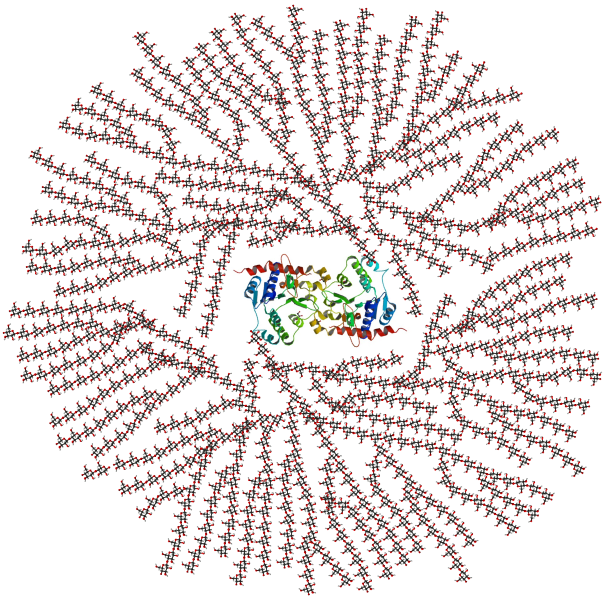 |
| Glycogen, containing ~ 30,000 GUs branched every 8-12 units. A masterpiece. Liver glycogen's branching is novel in that it has more branches near the core, and fewer, larger branches on the periphery, reminding us that these are physical structures that must fit neatly in 3 dimensions. |
 |
| Amylopectin's massive 2 million GUs branched every 15-30 units. Contrary to proponents of the Paleo Diet, humans are uniquely adapted among primates to digest starches, so starch has been part of the human diet long enough to change our genetics. |
Human Metabolism of Carbohydrates
Polymers of carbohydrate present in starch and complex sugars are first attacked by salivary amylase in the mouth. Interestingly, the sweetness of certain grains, like waxy rice, is due to some of the starch being broken down into small enough polymers - nominally glucose - to be perceived as sweet.
Maltodextrin commonly used in sports nutrition have a DE of 9, where glucose is 100, so a GU of 100/9, or ~ 11. It is fairly easy to reduce that to glucose and maltose. The same is true for waxy rice's 3D "grape cluster" structure getting cleaved off the "vine" and attacked.
This brings up an important point. While many carbohydrates, such as starch, fructose, lactose, etc, have their own dedicated amylase that acts only on them, all amylase fall into 1 of 2 kinds. One kind attacks ONLY the branches of glucose polymers, and the other attacks ONLY the ends.
There isn't much for the latter to do with something long and unbranched, like amylose, which accounts for its much lower GI. Both amylases attack at random locations, but in highly branched polymers, breaking a single branch connection exposes dozens of ends. By contrast, breaking a linear polymer exposes only 2 ends.
This simple idea is why branching is much more important than polymer length in creating the high GI carbohydrates for optimal sports performance. (as a point of interest, the very best high explosives have this same, very complex branching structure, but with many oxygen atoms bound into the molecule, so that both the fuel and oxidizer are present in close proximity in explosives)
 |
| Intestinal villi's brush border has a surface area equal to a small 2 bdrm apt |
Well, first, you can beat that. Maltose, a disaccharide, has a GI of 105, higher than glucose's reference GI of 100. So do certain types of rice, potato, and dates, where certain varieties approach a GI of 140. This clearly indicates that the intestinal brush border is capable of simultaneously reducing glucose polymers, and absorbing the resulting glucose monomers.
(Dedicated amylase such as sucrase, and invertase, go unused if no sucrose is available, so adding sucrose to denser fuels, whose digestion occurs simultaneously, increases the total digestion rate, and that strategy is used by almost all commercial ride fuels, but these are supplements, not replacements for denser fuels)
For athletes, the real answer to why you can beat pure glucose is temperature. Cold, dense air increases VO2max, but minimizes electrolyte demands, so Gatorade's combined electrolyte, hydration, fuel strategy fails, and only denser fuels can provide the extra energy to fully utilize available oxygen. Heat is more insidious. It's a frontal assault on you ability to digest carbs, so optimal fuels are imperative.
Sugars are NOT very energy dense. Imagine how much straw you'd have to burn to keep warm in a really cold climate. Straw burns very fast, but it doesn't produce much heat. You could also burn balsa wood, spruce, pine, douglas fir, fruit wood, or oak. You still might not care what you burn if there were no limits to the bulk/volume of fuel you could burn, but there are. Think of your carb digestion rate as the size of the hole in the wall you have to pull fuel through. Denser fuel is obviously better, especially since HEAT shrinks the size of the hole.
Sugar, like salt, increases osmotic pressure (as much as 300 psi) as more of it is added to liquids like Gatorade. Increase the strength to get more fuel, and the osmotic pressure becomes so great your small intestine can no longer pull salt and glucose into your blood, so it passes undigested into your colon, where bacteria are eagerly awaiting their next meal. The by-product of that bacterial digestion is gas, and its attendant bloating. This limits the amount of sugar to about a 6% solution - exactly what Gatorade has.
When it gets hot, things go from bad to worse fast, because your body has to keep your core cool, and to do that it has to open your capillaries and start devoting a lot of small intestinal surface area to absorbing water to support sweating. This has 3 negative impacts.
First, it starves your digestive tract for blood, so even if your intestine hasn't completely shut down, there isn't enough blood to properly absorb all available glucose from the intestine.
Second, at some point, your small intestine can no longer absorb enough water to support sweating. Not to worry, your large intestine (colon) is not only ready to absorb more water, it's actually more efficient at it, BUT, when processing so much water, there isn't much time for carbohydrate digestion and absorption while transitioning through the small intestine. Any carbs that get past your small intestine, feed bacteria in your colon, which will ferment them, but are downstream of the point where they are of any use to you.
Third, you need sodium, usually from salt (sodium chloride) or sodium citrate, to unlock any and all transport sites in your small intestine so glucose can be transported into your blood. While this does not consume sodium, sweating does, and in large quantities on hot days. Glucose, wrested from long-chain polysaccharides by the action of amylase, ends up useless without adequate sodium, and ends up downstream in the colon, supporting fermentation with its attendant gas and bloating.
Initially, you can dilute your Gatorade mix, which is what I do, but in doing so, you have to add back electrolytes and carbs to make up for the dilution. There are lots of good electrolyte solutions out there, but that doesn't help make up for the lost carbs.
(With intense sweating, only salt and pure water will prevent gas and bloating, as carb digestion is completely shut down. The body's water absorption rate is the limiting factor for sports performance in intense heat, and that is very dependent on maintaining adequate sodium levels)
What's needed to prevent glycogen depletion is a denser fuel with a much lower osmotic pressure than sugar. Say hello to starch, or some derivative of it, like maltodextrin, with a GI of 105. While salt greatly enhances the rate of water absorption, with intense heat, carbs have to be consumed at 75% of max HR or less to reduce sweating. Salt, water, then food.
Now knowing what you do about the structure of carbohydrates, you'll be looking for a carbohydrate with a structure like liver or muscle glycogen. Highly branched, and very densely packed. Obviously, amylopectin meets this criteria, and accounts for the large difference in GIs amongst rice varieties with high and low percentages of amylose.
Maltodextrin squeaks by because it has ~ 11GUs, and a much lower osmotic pressure than sugar. It doesn't leave much for the branch-breaking amylase to do though, relying solely on linear polymer reduction by end-breaking amylase. I'm guessing, but I think all that type-specific, unemployed amylase becomes part of the problem.
High amylose starch is necessarily low amylopectin. All starch is one or the other. The former has GIs in the 60s, and the latter in the high 80s. In fact, short-grain waxy rice has zero, or very near zero amylose, and certain varieties have a GI of over 130. (item #293)
Relatively small amounts of fuels this dense, supplemented with small amounts of sucrose and fructose to make max use of all types of amylose, will produce as much glucose as a balanced attack by all varieties of human amylase can sustain, and the intestinal brush border can absorb. It can do so with NO osmotic pressure problems. This is like burning 400 yr old English Oak, with straw and pine sawdust blown into a fire mixed with compressed air. WOOSH!!!
 |
| Glycemic Index and Insulin Index of Selected Rices |
We're not quite done with our story though. Until now this discussion has been entirely about how to maximize the sustained rate at which we can get glucose into the bloodstream, but this is only half of the problem. We still need to get that glucose moved through muscle cells' outer membrane, and into the cell's mitochondria. Without the action of the hormone insulin, all that glucose is locked out of the muscle, and essentially worthless, so how can we maximize an insulin response to use a maximized glucose delivery? Choose foods that solve both halves of this problem.
Look back up to the two GI graphs. One for venous, and one for capillary glucose. Remember the huge difference in those levels is due entirely to the effect of insulin on large skeletal muscles. Now look at the insulin index of Waxy rice above. Even though the GI of waxy rice is lower than Pelde white rice, the insulin index is a staggering 32 points higher! (we might also suspect that such a high level of insulin is lowering the observed GI by increasing the rate at which measurable glucose is being absorbed by either adipose tissues, or large skeletal muscles)
Have you ever had a 15-20 minute interval where your strength was super-human? We've all seen these displays by professional athletes. They're the stuff of legend. I'm speculating here, but I think those incredible moments of strength are due to a convergence of high blood glucose and high insulin levels. The pancreas does not release insulin on a continuous basis, but at approximately 6 minute intervals, or as short as 3 minute intervals in highly trained athletes. After this flood of insulin is released into the blood, it's monitored for depletion. For athletes, carbs that induce a larger release of insulin are better carbs.
In summary, looking at the GI of many foods, it seems clear to me that the gains made by sports nutrition companies in "predigesting" starch carbohydrate into shorter, linear glucose polymers (maltodextrin and brown rice syrup), has reached a plateau. It looks like the way forward is to find varieties of rice, or perhaps other starchy grains, which naturally have very high GIs, investigate their branching structures, and cross breed or genetically engineer "super fuels" - which may have GIs close to 150, and provoke intense insulin responses. Such a break-through is more likely to come from Monsanto than Hammer, as the research effort will surely be large and expensive.
Ironically, this investigation has already begun, but it's focused in the opposite direction - to find or create lower GI grains to address the obesity epidemic. The table above was taken from such a study. It may seem a frivolous endeavor to find a "super fuel", but imagine the benefit for infantry to have a fuel that will stave off glycogen depletion from sunrise to sunset on the longest day. It, of course, is also of great interest to those of us who compete against time and reason to find satisfaction and glory.
Subscribe to:
Posts (Atom)